
Why Real-Time Intelligence Beats Manual Audits for Effortless Accuracy
May 15, 2026
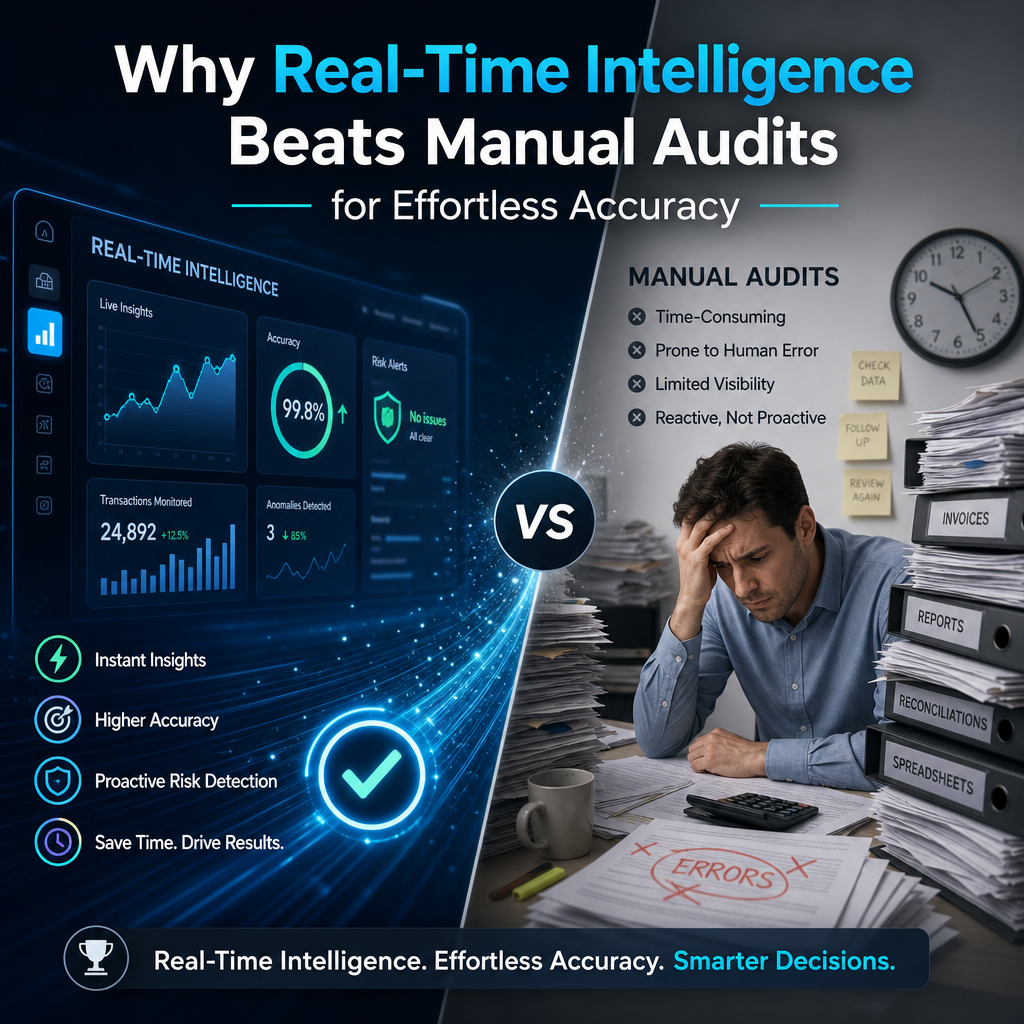
Why real-time intelligence beats manual audits is a question increasingly relevant in today’s fast-paced business environment. As organizations strive for accuracy and efficiency, relying solely on traditional manual audits can create bottlenecks, errors, and missed opportunities. Real-time intelligence offers an automated, dynamic approach that enhances accuracy without the labor-intensive challenges manual audits present. Exploring this contrast reveals why businesses are making the shift to intelligent, real-time solutions.
Understanding Real-Time Intelligence Versus Manual Audits
Manual audits have long been the standard for verifying accuracy and compliance in various industries. These audits require human auditors or employees to review data, transactions, or operations after the fact. The process is often periodic, time-consuming, and prone to human error. While they have their place, manual audits are limited by the speed and scope humans can handle efficiently.
Conversely, real-time intelligence refers to using advanced technologies like artificial intelligence, machine learning, and big data analytics to continuously monitor and analyze data as it flows through systems. This method enables immediate detection of discrepancies, risks, or anomalies, allowing organizations to act swiftly and decisively. Unlike manual audits that look backwards, real-time intelligence offers ongoing oversight and instantaneous insights.
Why Real-Time Intelligence Beats Manual Audits: Key Advantages
1. Enhanced Accuracy and Consistency
Manual audits depend heavily on human attention and interpretation, introducing the potential for oversight and inconsistency. Even well-trained auditors can miss subtle patterns or make mistakes under pressure. Real-time intelligence, powered by automated algorithms, processes vast amounts of data uniformly and without fatigue. This reduces errors and ensures consistent application of rules and controls.
2. Immediate Detection and Resolution
Unlike manual audits that occur after a reporting period, real-time intelligence identifies issues as they happen. This immediacy is critical for preventing fraud, compliance violations, or operational flaws before they escalate. By catching problems early, organizations can take corrective measures without waiting for a scheduled audit, minimizing financial loss and reputational damage.
3. Scalability and Efficiency
Manual audits require substantial resources, often involving teams of auditors working long hours to review extensive data sets. Scaling audits across larger or more complex operations becomes costly and impractical. Real-time intelligence automates continuous monitoring regardless of data volume or complexity, allowing businesses to scale oversight seamlessly as they grow, all while saving time and reducing labor costs.
4. Improved Decision Making
Access to real-time insights gives decision-makers a clearer understanding of current operational and financial states. This empowers them to make informed choices quickly rather than relying on outdated audit reports. In turn, businesses become more agile, responding rapidly to market changes, regulatory requirements, or internal risks.
5. Better Compliance and Risk Management
Regulatory landscapes are evolving, imposing stricter mandates on organizations to maintain accurate records and reliable reporting. Real-time intelligence helps ensure continuous compliance by flagging deviations instantly and providing audit trails automatically. This proactive approach reduces the risk of penalties and enhances trust with stakeholders.
Practical Applications Across Industries
Several industries benefit significantly from adopting real-time intelligence over manual audits.
– Finance: Fraud detection systems use real-time analytics to spot suspicious transactions immediately, reducing credit card fraud and money laundering risks.
– Manufacturing: Continuous monitoring of production data helps identify quality control issues or equipment malfunctions before they cause costly defects or downtime.
– Healthcare: Real-time compliance checks ensure patient records and billing practices meet regulatory standards, avoiding costly audit failures.
– Retail: Inventory tracking and sales data analytics enable timely adjustments to stock levels and promotional strategies, enhancing profitability.
Overcoming Challenges in Implementing Real-Time Intelligence
While real-time intelligence offers numerous benefits, implementation requires careful planning. Organizations must invest in the right technologies, integrate systems seamlessly, and train personnel to interpret and act on automated insights effectively. Data privacy and security considerations are paramount to maintain customer trust and comply with regulations.
Conclusion
Why real-time intelligence beats manual audits comes down to its ability to deliver effortless accuracy through continuous, automated, and scalable monitoring. By replacing labor-intensive, error-prone manual processes with intelligent technology, organizations improve accuracy, responsiveness, and compliance. This transformation is essential in an era driven by data volume, speed, and complexity—making real-time intelligence not just an option, but a necessity for businesses striving for operational excellence.