Utility Revenue Assurance: Must-Have Lessons to Stop Costly Revenue Leakage
May 17, 2026
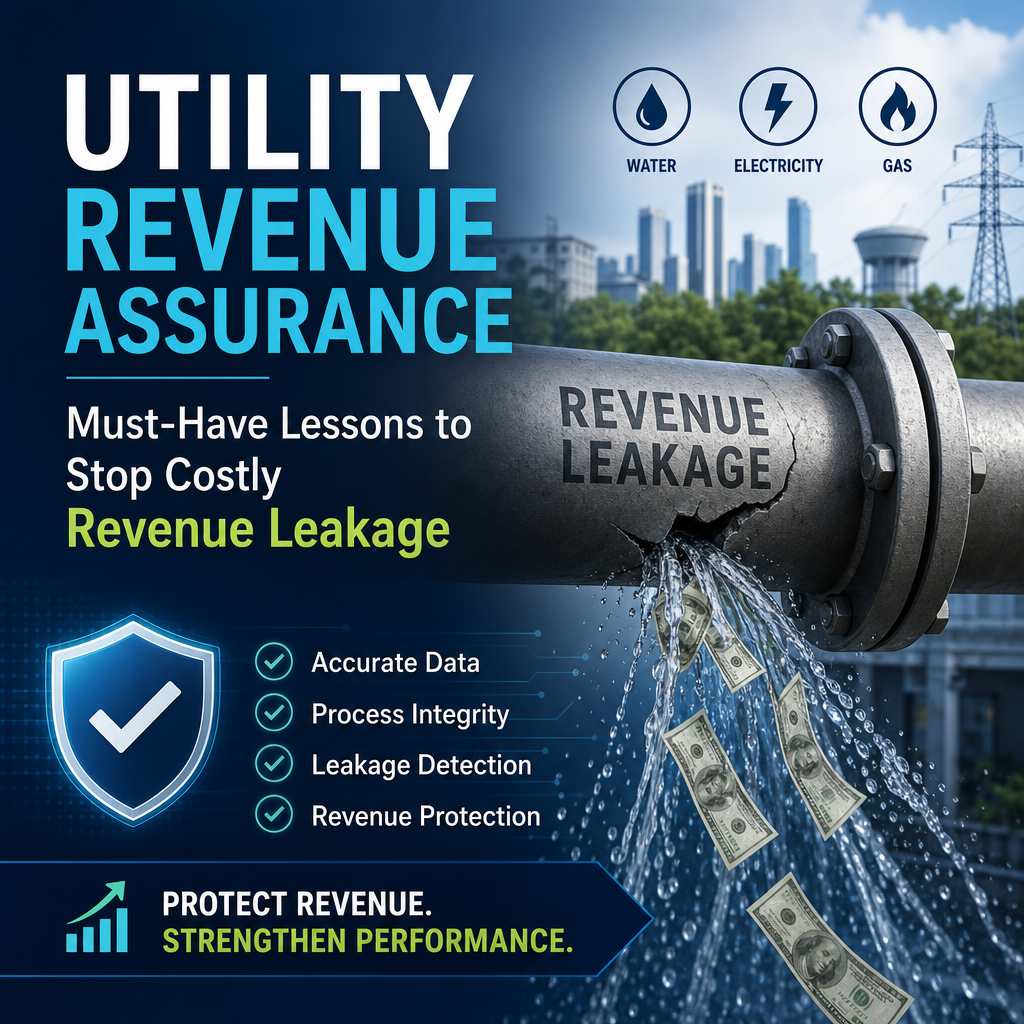
Utility revenue assurance is a critical discipline that utility companies must embrace to address one of their most pressing challenges: revenue leakage. Revenue leakage occurs when utilities fail to collect the full amount owed for their services due to operational inefficiencies, technical losses, billing errors, or fraud. This shortfall in revenue can severely impact a utility’s profitability, sustainability, and capacity to invest in infrastructure upgrades. Understanding how to implement effective utility revenue assurance measures is essential for stopping costly revenue leakage and ensuring that utilities maintain financial health.
What is Utility Revenue Assurance?
Utility revenue assurance involves a systematic approach to detecting, preventing, and recovering lost revenues within the service lifecycle. It covers everything from meter data accuracy and billing processes to customer management and regulatory compliance. The goal is to create a closed-loop system where all consumed energy or water is accurately measured, billed, and collected without losses slipping through gaps in the system.
The Impact of Revenue Leakage on Utilities
Revenue leakage can arise from several factors, including inaccurate meter readings, data entry errors, unauthorized consumption, theft, and inefficient operational processes. These losses often go unnoticed until month-end or quarterly financial reviews when there’s an obvious gap between delivered units and billed units. The financial impact is not just immediate but also long-term—reduced cash flow hampers the ability to maintain services, invest in innovation, and meet regulatory requirements.
For utilities operating on thin margins, leakage can be a significant threat to survival. It can also lead to higher tariffs for honest-paying customers as utilities try to compensate for lost income, ultimately undermining public trust and satisfaction.
Must-Have Lessons in Utility Revenue Assurance to Stop Revenue Leakage
1. Leverage Smart Metering and Advanced Meter Data Management
One of the most effective tools in combating revenue leakage is the deployment of smart metering technology. Smart meters provide real-time, accurate readings, eliminating many human errors associated with manual meter reading and estimation. Coupled with advanced Meter Data Management (MDM) systems, utilities can automate data validation, trend analysis, and anomaly detection, making it easier to identify discrepancies indicative of theft or equipment malfunction.
2. Implement Robust Data Analytics and Predictive Tools
Modern revenue assurance requires investing in analytics platforms that aggregate billing, consumption, and operational data to provide actionable insights. Predictive analytics can forecast demand patterns, meter behavior, and potential leakage points, enabling proactive measures. Early detection via analytics helps utilities reduce non-technical losses and streamline revenue recovery processes.
3. Conduct Regular Audits and Meter Testing
Even with automated systems, periodic audits remain essential. Regular inspections ensure meters are functioning correctly and that billing systems reflect actual consumption. Audits can also uncover regulatory compliance issues, contractual discrepancies, and flaws in data handling procedures. Establishing a routine audit schedule signals a commitment to transparency and accountability.
4. Prioritize Employee Training and Cross-Functional Collaboration
Revenue assurance is not purely a technological challenge; human factors play a significant role as well. Utilities must train staff across the billing, customer service, and field operations teams to recognize potential leakage signs and understand the importance of accurate data handling. Encouraging cooperation between departments ensures that discrepancies are investigated swiftly and systematically.
5. Strengthen Customer Engagement and Communication
Many revenue leakage issues stem from customer disputes or misunderstandings about billing. Utilities can reduce revenue loss by improving communication and offering customers clear billing explanations, usage alerts, and flexible payment options. Engaged customers are more likely to report meter issues and resolve disputes promptly, reducing leakage risks.
6. Utilize Integrated Revenue Assurance Solutions
Fragmented systems are prone to errors and inconsistencies that lead to revenue leakage. Adopting integrated IT solutions that bridge the gap between meter data collection, billing, customer management, and revenue protection functions can eradicate silos and enhance accuracy. Integration facilitates end-to-end visibility and control over the revenue lifecycle.
Conclusion: Prioritizing Utility Revenue Assurance to Safeguard Financial Health
Stopping costly revenue leakage is vital to the sustainability and growth of utility providers. By embracing utility revenue assurance best practices—smart metering, sophisticated analytics, regular audits, skilled workforce training, customer engagement, and integrated systems—utilities can minimize revenue loss, improve operational efficiency, and provide better service to their customers. Prioritizing revenue assurance is not merely an operational tactic; it is a strategic imperative to secure the future viability of utilities in an increasingly complex regulatory and market environment.