
Revenue Visibility Challenges: Exclusive Insights for Effortless Enterprise Systems
June 28, 2026
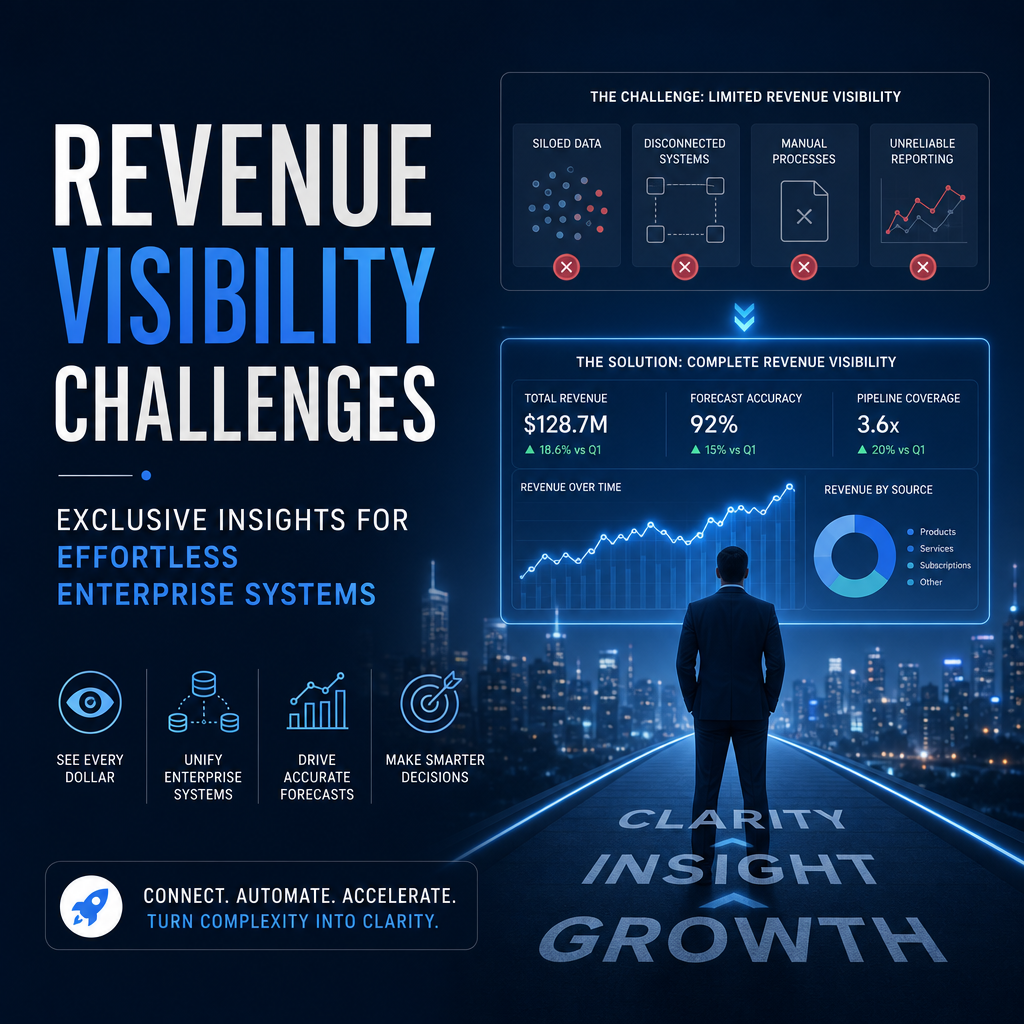
Revenue visibility is a critical component for any business striving to maintain financial health and gain a competitive edge. In the era of digital transformation, enterprise systems serve as the backbone for managing vast amounts of data related to sales, finance, and operations. However, despite the advanced capabilities of modern enterprise systems, many organizations still face significant revenue visibility challenges that hinder their ability to make timely, informed decisions. This article explores these challenges and offers exclusive insights into overcoming them for effortless revenue management.
Understanding Revenue Visibility in Enterprise Systems
Revenue visibility refers to an organization’s ability to accurately track, analyze, and predict its revenue streams at any given time. For enterprises, this means having clear insight into current sales performance, outstanding contracts, recurring revenue, and potential revenue risks. Enterprise systems, such as ERP (Enterprise Resource Planning), CRM (Customer Relationship Management), and CPQ (Configure, Price, Quote) platforms, are designed to consolidate and automate data flow across departments. Yet, integrating these complex systems effectively to achieve seamless revenue visibility remains a challenge for many companies.
Common Revenue Visibility Challenges in Enterprise Systems
Data Silos and Fragmented Systems
One of the primary barriers to achieving complete revenue visibility is the existence of data silos within an organization. Often, sales, finance, and operations teams use different systems that are not well integrated, resulting in fragmented data sets. This fragmentation prevents real-time synchronization of revenue data, leading to inaccuracies and delayed reporting. Without a unified view, companies struggle to understand the true financial performance and identify revenue leakage proactively.
Complex Pricing and Contract Terms
Enterprise customers often face complex pricing models, including volume discounts, tiered pricing, rebates, and multi-year contracts. These intricacies make it difficult for enterprise systems to capture and reflect revenue accurately without manual intervention. Revenue recognition rules further complicate the picture, especially when enterprises must comply with accounting standards such as ASC 606 or IFRS 15. This complexity often creates blind spots in revenue tracking, contributing to poor forecasting and compliance risks.
Inadequate Real-Time Reporting Capabilities
Many enterprise systems lack the ability to provide real-time revenue insights. Traditional reporting tools often operate on batch processes that refresh data after delay, leading to decisions based on outdated information. In a competitive market environment, this lag can cause missed opportunities or delayed responses to emerging risks. Businesses today require dashboards and analytics that offer immediate visibility into the key revenue metrics, empowering frontline teams to act swiftly.
Manual Processes and Human Error
Despite advances in automation, manual processes are still prevalent in revenue management workflows. Spreadsheet-based consolidation, manual data entry, and offline approvals introduce risks of human error that can distort revenue figures. Enterprises that rely heavily on manual intervention often encounter bottlenecks, reduce operational efficiency, and erode stakeholder confidence in financial data.
How to Overcome Revenue Visibility Challenges for Effortless Enterprise Systems
Embrace Integrated Platforms with End-to-End Connectivity
Achieving effortless revenue visibility starts with adopting enterprise systems that can seamlessly connect sales, finance, and operations. Integrated platforms that support data interoperability reduce the risks of silos and ensure consistent, up-to-date revenue information across the organization. Modern cloud-based ERP and CRM solutions often come with APIs and native connectors that enable smooth data flow and automatic updates.
Leverage Automation and AI for Revenue Management
Automation plays a crucial role in minimizing manual errors and accelerating revenue processes. Solutions embedded with AI capabilities can help analyze complex pricing scenarios, enforce compliance with accounting standards, and detect anomalies in revenue data. Automated workflows for contract management, invoicing, and revenue recognition enable faster close cycles and reliable reporting.
Invest in Real-Time Analytics and Revenue Forecasting Tools
Deploying real-time analytics dashboards provides stakeholders with instant access to revenue metrics, sales pipeline health, and customer trends. Advanced forecasting tools powered by machine learning can predict future revenue streams based on historical data and market variables, helping executives make proactive decisions. The ability to drill down into granular data empowers teams to identify growth opportunities and mitigate revenue leakage efficiently.
Standardize Data Governance and Training
Establishing clear governance frameworks and standardized data definitions ensures uniformity in how revenue components are captured and reported across business units. Comprehensive staff training on enterprise systems and revenue processes further reduces errors and fosters accountability. When users trust the data they access, strategic alignment and financial transparency improve significantly.
Conclusion
Revenue visibility challenges in enterprise systems can create significant obstacles for organizations seeking to optimize financial performance and strategic planning. The secret to effortless revenue management lies in harnessing integrated technology platforms, embracing automation, advancing real-time analytics, and enforcing robust governance practices. By addressing these pain points proactively, enterprises unlock accurate, transparent, and timely insights into their revenue streams—empowering them to drive sustainable growth in an increasingly complex business landscape.