
Real-Time Intelligence: The Must-Have AI Audit for Effortless Accuracy
July 1, 2026
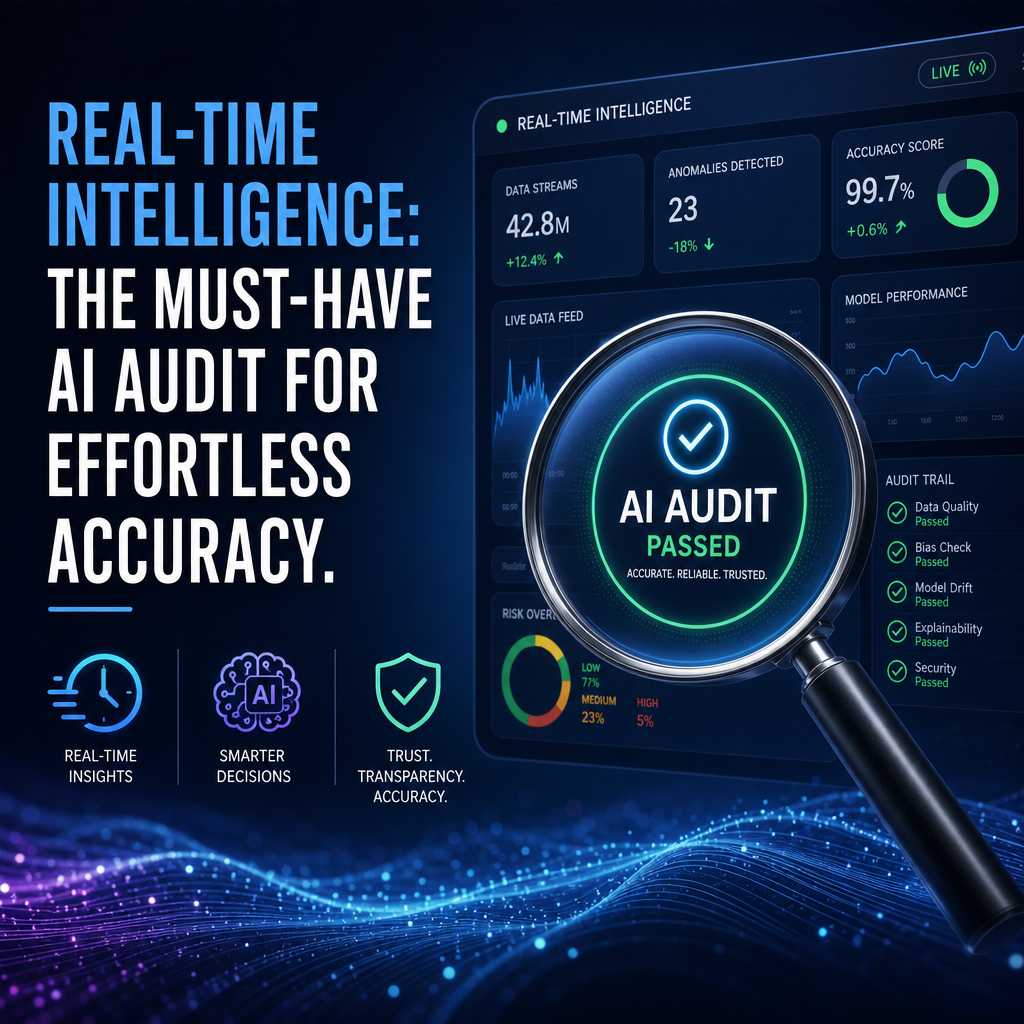
Real-time intelligence has become a cornerstone for businesses and organizations striving to maintain accuracy and efficiency in an increasingly data-driven world. As artificial intelligence (AI) technologies continue to evolve, integrating an AI audit with real-time intelligence processes is no longer optional—it’s a necessity. This combination ensures data integrity, improves decision-making, and helps guard against biases and errors that could otherwise compromise outcomes.
What Is Real-Time Intelligence and Why It Matters
Real-time intelligence refers to the continuous gathering, processing, and analysis of data as events occur. Unlike traditional batch processing, which reviews data after set intervals, real-time intelligence provides instant insights that enable immediate action. For businesses, this can translate into faster responses to customer needs, quicker detection of fraud, or improved operational efficiency.
The power of real-time intelligence lies in its ability to adapt dynamically to fresh information. However, with the volume and velocity of data skyrocketing, ensuring the reliability and accuracy of real-time outputs becomes complex. That’s where a robust AI audit steps in to oversee the integrity of AI-infused workflows.
The Role of an AI Audit in Enhancing Real-Time Intelligence
An AI audit is a systematic evaluation of artificial intelligence systems, focusing on transparency, accuracy, fairness, and compliance with regulations. When applied to systems utilizing real-time intelligence, the AI audit acts as a guardian that verifies the quality and trustworthiness of the real-time data analytics.
For instance, in industries like finance or healthcare, where real-time decisions carry significant risks, an AI audit can identify potential biases embedded in machine learning models or detect anomalies in data streams that might signal erroneous outputs. This proactive approach minimizes the likelihood of costly mistakes and helps organizations meet ethical standards and legal requirements.
Key Benefits of Conducting an AI Audit for Real-Time Intelligence
1. Ensuring Data Accuracy and Completeness
The foundation of real-time intelligence is accurate data. An AI audit reviews data pipelines to guarantee that incoming data is clean, relevant, and processed correctly. By validating data inputs and model outputs at each step, the audit reduces the chances of flawed insights originating from corrupted or incomplete data.
2. Increasing Transparency and Accountability
AI systems can often behave as “black boxes,” making it hard to understand how decisions are derived. The AI audit sheds light on algorithms, providing transparency into the decision-making process. This openness builds trust among stakeholders and enables organizations to explain how real-time intelligence outcomes are produced.
3. Detecting and Mitigating Bias
AI algorithms are known to sometimes perpetuate or amplify biases present in training data or decision frameworks. An AI audit assesses these risks within real-time intelligence systems, recommending adjustments to models or data to promote fairness and inclusivity.
4. Enhancing Compliance with Regulations
Data privacy laws and industry-specific regulations increasingly govern the use of AI and data analytics. An AI audit ensures that real-time intelligence systems comply with norms such as GDPR, CCPA, or HIPAA, avoiding legal penalties and protecting customer rights.
How to Integrate Real-Time Intelligence and AI Audit in Your Organization
To fully harness the benefits of real-time intelligence with the assurance of AI audit, organizations should take a structured approach:
– Start with Clear Objectives: Define what insights you need from real-time intelligence and identify where AI plays a role in data processing.
– Implement Monitoring Tools: Use AI audit platforms that continuously check for errors, bias, data drift, and other anomalies as data flows through systems.
– Engage Cross-Functional Teams: Include data scientists, IT professionals, compliance officers, and business stakeholders in audit planning and execution.
– Establish Regular Review Cycles: Real-time intelligence environments evolve quickly, so frequent AI audits help keep systems aligned with organizational goals and compliance needs.
– Invest in Training: Educate your teams on the principles of AI accountability and the importance of real-time data integrity.
Future Outlook: Real-Time Intelligence Shaped by AI Audits
As AI capabilities advance, the intersection of real-time intelligence and AI audits will become even more critical. Emerging technologies like explainable AI (XAI) and automated audit tools will make continuous validation more accessible and efficient. Organizations that embrace this paradigm will not only improve accuracy and trust but also gain a competitive edge by making faster, smarter decisions grounded in reliable insights.
In summary, real-time intelligence supported by a thorough AI audit is essential for achieving effortless accuracy in today’s fast-paced data environments. By prioritizing this combination, businesses can unlock deeper insights, mitigate risk, and build lasting confidence in their AI-powered operations.