
Revenue Intelligence Transformation: Stunning Before and After Results Revealed
May 31, 2026
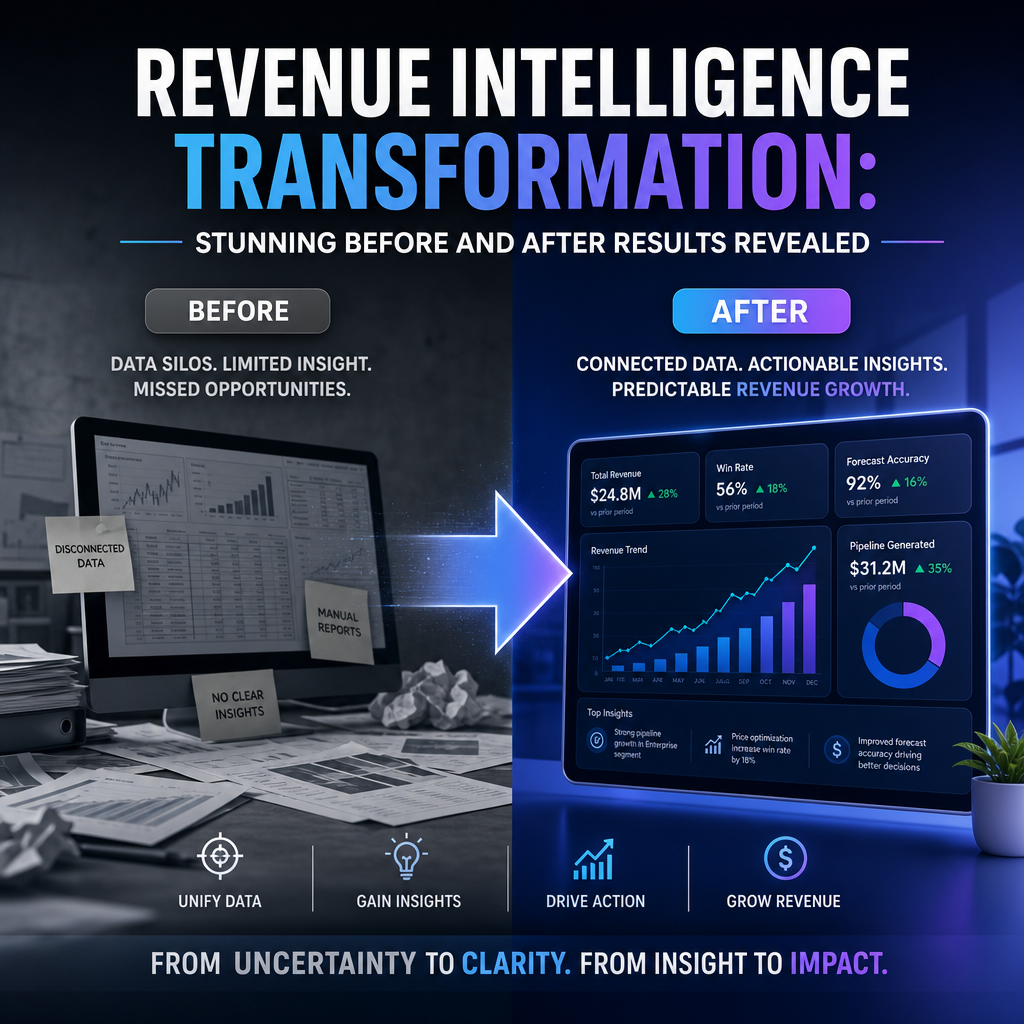
Revenue intelligence transformation has emerged as a game-changer for organizations looking to maximize their sales potential and improve overall business outcomes. By leveraging advanced data analytics, artificial intelligence, and real-time insights, companies can revolutionize their revenue operations. The results of such transformations are often dramatic, showcasing measurable improvements in forecasting accuracy, deal velocity, customer retention, and revenue growth.
Understanding revenue intelligence transformation involves diving into how businesses move from traditional, fragmented sales processes to a data-driven, cohesive model that empowers teams with actionable intelligence. This article explores the stunning before and after results that organizations experience when they undertake this vital shift, illustrating why revenue intelligence is no longer optional but essential for competitive success.
What Is Revenue Intelligence Transformation?
At its core, revenue intelligence transformation signifies the integration of AI-powered systems that collect and analyze data across the entire customer journey—from initial lead generation to deal closure and beyond. This transformation enables sales and revenue teams to gain deep visibility into customer behaviors, deal progress, and sales team performance, often in real-time.
Before revenue intelligence tools, many companies relied heavily on manual input and disconnected systems for forecasting and pipeline management. This often resulted in inaccurate sales forecasts, missed upselling opportunities, and inefficient resource allocation. Revenue intelligence technology consolidates multiple data sources, including CRM platforms, email communications, call recordings, and market trends, to provide a single source of truth. This holistic view drives informed decision-making and continuous revenue optimization.
The Stunning Before and After Results of Revenue Intelligence Transformation
Improved Forecast Accuracy and Predictability
One of the earliest and most transformative outcomes of revenue intelligence transformation is the dramatic improvement in sales forecast accuracy. Before adoption, organizations often struggled with overestimating or underestimating revenue, leading to inventory imbalances, poor resource planning, and missed financial goals.
After integrating revenue intelligence platforms, companies report forecast accuracy improvements ranging from 20% to 50%. These tools analyze historical data, current pipeline health, and external factors to provide data-driven predictions. As a result, sales leaders can confidently set realistic targets and allocate resources optimally, reducing surprises during quarterly reviews.
Accelerated Deal Velocity and Win Rates
Revenue intelligence transformation enhances the entire sales cycle by providing frontline sellers with insights that allow them to prioritize high-probability deals, identify potential objections early, and tailor messaging based on data-driven customer profiles. Before this transformation, many teams followed a one-size-fits-all approach that often led to lengthy sales cycles and lower win rates.
After transformation, businesses notice faster deal closures and higher win rates. Some companies report deal velocity improvements of up to 30%, which translates directly into increased revenue within shorter timeframes. By leveraging personalized nudges and AI-driven recommendations, sales reps become more effective and motivated, ultimately elevating overall team performance.
Enhanced Customer Retention and Expansion
Revenue intelligence transformation also impacts the post-sale experience by enabling deeper insights into customer health and satisfaction. Prior to embracing these technologies, customer success teams often lacked the necessary context or early warning signals to proactively address churn risks.
With real-time analytics and sentiment analysis, organizations can identify at-risk customers and upsell opportunities before they become apparent through traditional means. As a result, companies experience reduced churn rates and increased customer lifetime value (CLTV), fostering stronger, long-term relationships. In many cases, revenue intelligence drives double-digit improvements in customer retention and net revenue retention metrics.
Key Elements Driving Successful Revenue Intelligence Transformation
Integration Across Departments
For a revenue intelligence transformation to be truly effective, it requires breaking down silos between sales, marketing, customer success, and finance teams. When these departments share insights seamlessly, companies create a unified revenue ecosystem that drives growth from all angles.
Continuous Data Quality Enhancement
The reliability of revenue intelligence insights depends on clean, accurate, and complete data. Organizational commitment to data hygiene and governance is vital throughout the transformation process to ensure decision-makers trust the outputs.
Training and Change Management
Transforming how teams interact with data and new technologies demands robust training and cultural shifts. Companies that invest in onboarding and ongoing support see higher adoption rates and sustainable results, making the transition smoother and more impactful.
Looking Ahead: The Future of Revenue Intelligence Transformation
As AI, machine learning, and automation technologies continue to evolve, revenue intelligence transformation promises even more sophisticated capabilities. Predictive analytics will grow smarter, natural language processing will provide richer conversation insights, and integration with emerging sales channels will expand revenues further.
Companies that embrace this ongoing transformation will maintain competitive advantages by making smarter, faster revenue decisions and delivering exceptional customer experiences.
—
In summary, revenue intelligence transformation profoundly reshapes how companies approach revenue operations, producing stunning before and after results that impact accuracy, efficiency, customer relationships, and overall growth. By adopting data-driven insights and fostering cross-functional collaboration, businesses unlock powerful opportunities for success in an increasingly competitive market landscape.