
Real-Time Intelligence: The Must-Have Advantage Over Manual AI Audits
May 27, 2026
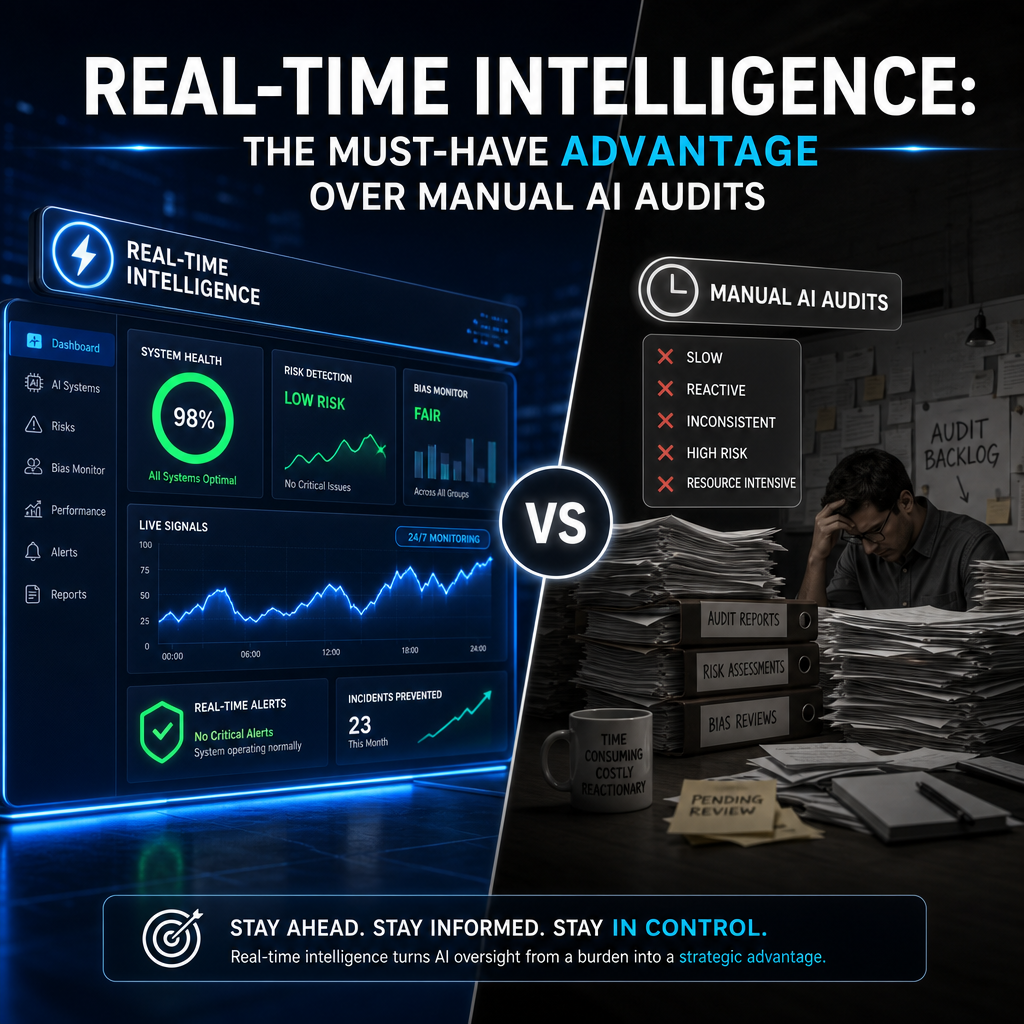
Real-time intelligence has become a critical differentiator for businesses seeking to maintain a competitive edge, especially when contrasted with the traditional approach of manual AI audits. As organizations increasingly rely on artificial intelligence to drive decision-making, the need for continuous, up-to-date insights into AI system performance is more important than ever. Unlike manual AI audits, which are often time-consuming and sporadic, real-time intelligence offers dynamic monitoring and instant feedback that can significantly enhance the efficiency, accuracy, and trustworthiness of AI technologies.
Why Real-Time Intelligence Outperforms Manual AI Audit Methods
Manual AI audits typically involve periodic evaluations, where data scientists or auditors review AI algorithms, models, and outputs to identify biases, errors, compliance issues, or performance gaps. While these audits are essential for due diligence, the intermittent nature means problems may go undetected for weeks or months, risking flawed decisions or regulatory penalties.
Real-time intelligence, on the other hand, integrates continuous monitoring and automated analysis, enabling organizations to detect anomalies, biases, or performance degradation as they happen. This proactive approach empowers teams to address issues before they escalate, ensuring AI outputs remain reliable and aligned with ethical and operational standards.
Enhancing Accuracy and Responsiveness with Real-Time Intelligence
One of the key advantages of real-time intelligence is its ability to process vast amounts of data instantaneously, providing richer and more nuanced insights than a manual AI audit could offer during its scheduled reviews. For example, a financial services firm utilizing AI for credit scoring benefits immensely by identifying shifts in model behavior immediately after new data inputs or external events, allowing adjustments in real time to avoid incorrect risk assessments.
Moreover, real-time intelligence helps maintain compliance with evolving regulatory requirements by continuously monitoring AI systems against a dynamic set of rules and standards. Manual audits cannot adapt as quickly to regulatory changes or emerging ethical guidelines, potentially leaving organizations exposed to non-compliance and reputational damage.
Cost Efficiency and Scalability of Real-Time Intelligence Systems
Implementing real-time intelligence solutions reduces the operational burdens associated with manual AI audits. Continuous, automated monitoring decreases the need for large audit teams and extensive downtime for review processes. By catching issues early, organizations avoid costly remediation efforts required when errors are discovered late in the process.
Additionally, real-time intelligence scales more effectively as organizations grow and their AI deployments become more complex. Manual audits struggle with scalability because they rely heavily on human involvement and discrete assessment windows. Real-time systems, powered by advanced analytics and machine learning, can track numerous AI models across diverse environments simultaneously, ensuring consistent oversight.
Building Trust Through Transparency and Accountability
Incorporating real-time intelligence into AI governance frameworks enhances transparency for stakeholders, including customers, regulators, and internal teams. Continuous insights provide a clear audit trail, demonstrating responsible AI management practices that foster confidence and accountability.
For industries like healthcare, legal, and finance where AI decisions have significant real-world implications, sustaining trust is paramount. Real-time intelligence enables real-time reporting and alert mechanisms, making it easier to explain AI decision pathways, detect biases quickly, and validate compliance efforts continuously.
The Future of AI Governance Lies in Real-Time Intelligence
While manual AI audits will always have a role in comprehensive AI governance, they cannot match the speed and adaptability that real-time intelligence brings to the table. As AI systems grow more integrated into critical business processes, relying solely on periodic checks leaves too much risk exposed.
Embracing real-time intelligence equips organizations with a must-have advantage—ongoing visibility and control—that maximizes the return on AI investments while mitigating operational, ethical, and regulatory risks. By integrating real-time intelligence into AI audit strategies, businesses can confidently harness the power of AI with continuous assurance of its performance and integrity.
In summary, real-time intelligence transforms AI governance from reactive to proactive, delivering unparalleled visibility, responsiveness, and scalability. As AI technology continues to advance rapidly, organizations that prioritize real-time intelligence over traditional manual AI audits will be best positioned to thrive in the evolving digital landscape.