
Why Real-Time Intelligence Beats Manual Audits for Effortless Accuracy
May 15, 2026
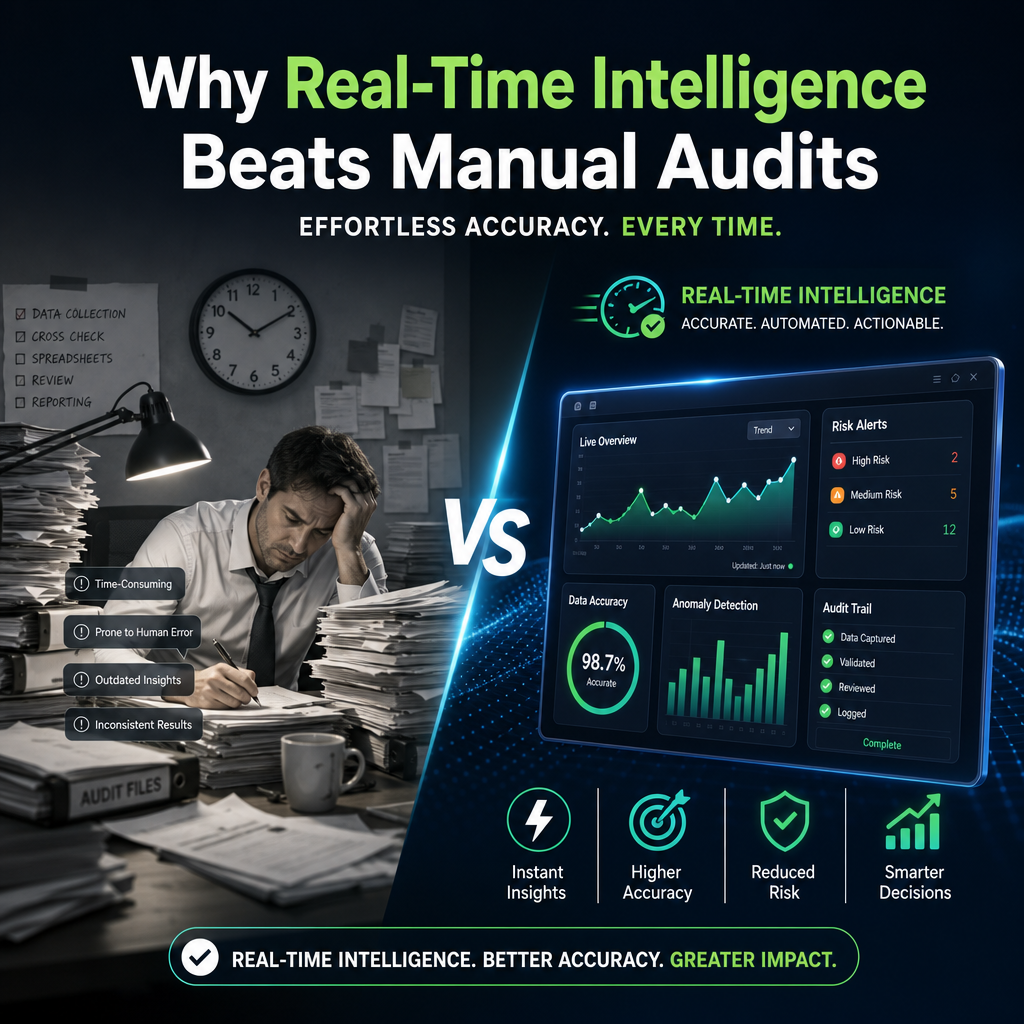
Why real-time intelligence beats manual audits is a question increasingly relevant in today’s fast-paced business environment where accuracy and efficiency are paramount. Traditional manual audits, while thorough, often fall short under the pressure of large data volumes, rapid operational changes, and the need for immediate insights. Real-time intelligence offers a compelling alternative that not only streamlines the auditing process but also enhances accuracy and decision-making capabilities.
The Limitations of Manual Audits
Manual audits have long been the cornerstone of verifying data accuracy and compliance within organizations. These audits typically involve human inspectors reviewing records, cross-checking information, and compiling reports over days or even weeks. Although effective for detailed examinations, manual audits present several notable drawbacks:
– Time-intensive processing: Manual data review can take significant time, especially when dealing with vast datasets or complex operations.
– Higher risk of human error: Fatigue, oversight, and inconsistent procedures can lead to mistakes that undermine audit credibility.
– Delayed insights: By the time an audit report is compiled, the data may no longer reflect the current reality, delaying corrective actions.
– Resource-heavy: Manual auditing requires a trained workforce and repetitive administrative tasks, increasing operational costs.
These limitations highlight why traditional audits alone are insufficient in dynamic industries that demand agility and real-time oversight.
Understanding Real-Time Intelligence in Auditing
Real-time intelligence refers to the continuous collection, analysis, and visualization of data as it is generated, enabling instant monitoring and decision-making. In the context of audits, this means leveraging technology — such as automated data capture, artificial intelligence, machine learning, and integrated dashboards — to evaluate data streams continuously rather than in periodic snapshots.
By integrating real-time intelligence tools, businesses can flag anomalies, track compliance status, and verify transactions instantly without waiting for manual intervention. This approach revolutionizes audit processes from reactive checks to proactive governance.
Why Real-Time Intelligence Beats Manual Audits for Effortless Accuracy
1. Immediate Detection of Irregularities
Manual audits inherently involve lag between data generation and review, allowing errors or fraudulent activities to persist unchecked for extended periods. Real-time intelligence continuously analyzes data inputs and can instantly identify discrepancies or deviations from expected patterns. This means businesses gain the ability to act swiftly, correcting issues before they escalate, thereby maintaining accuracy effortlessly.
2. Enhanced Data Accuracy with Automation
Automated data collection minimizes human input errors, which are common in manual data entry and processing. Real-time intelligence systems employ validation rules and algorithms to ensure data consistency. The result is cleaner, more reliable data that forms a trustworthy basis for auditing conclusions. This reduces the need for repetitive reconciliation efforts typical of manual audits.
3. Cost and Time Efficiency
With real-time intelligence, organizations significantly reduce the resources needed to conduct audits. Continuous monitoring replaces exhaustive periodic checks, lowering labor costs and minimizing disruptions to operations. Additionally, faster detection and correction of errors prevent costly compliance breaches or operational failures, ultimately saving both time and money.
4. Comprehensive Coverage and Scalability
Manual audits often rely on sampling due to practical limitations, which can miss critical issues in unexamined data sets. Real-time intelligence enables full-scale data monitoring, ensuring no transaction or event is overlooked. Furthermore, these systems scale effortlessly with business growth, handling increasing data volumes without degradation in performance or accuracy.
5. Improved Regulatory Compliance
In an era of stringent regulatory standards, businesses must demonstrate continuous compliance. Real-time intelligence supports this by providing up-to-the-minute audit trails and compliance reporting. This capability allows organizations to generate reports instantly and confidently respond to regulatory inquiries, outperforming the slower, periodic production of audit documentation in manual processes.
Implementing Real-Time Intelligence for Better Auditing
Transitioning from manual audits to real-time intelligence involves adopting the right technologies and restructuring data workflows. Key steps include:
– Integrating automated data capture across all source systems to ensure comprehensive input.
– Deploying analytics platforms powered by AI and machine learning to process and interpret data streams effectively.
– Establishing rule-based alerts and exception reporting for instant anomaly identification.
– Educating audit and compliance teams to leverage real-time dashboards and digital tools for continuous monitoring.
– Aligning data governance policies to support transparent, auditable data in real-time.
Adapting these practices transforms auditing from a cumbersome ordeal to a seamless, ongoing process that enhances overall operational intelligence.
Conclusion
Why real-time intelligence beats manual audits becomes clear when considering the demands of modern business for speed, accuracy, and reliability. While manual audits have their place in deep dives and certain compliance checks, real-time intelligence empowers organizations with effortless accuracy through continuous oversight, automation, and quick responsiveness. Embracing this shift not only improves auditing outcomes but also drives smarter, more data-driven management that keeps organizations nimble and compliant in an ever-evolving landscape.